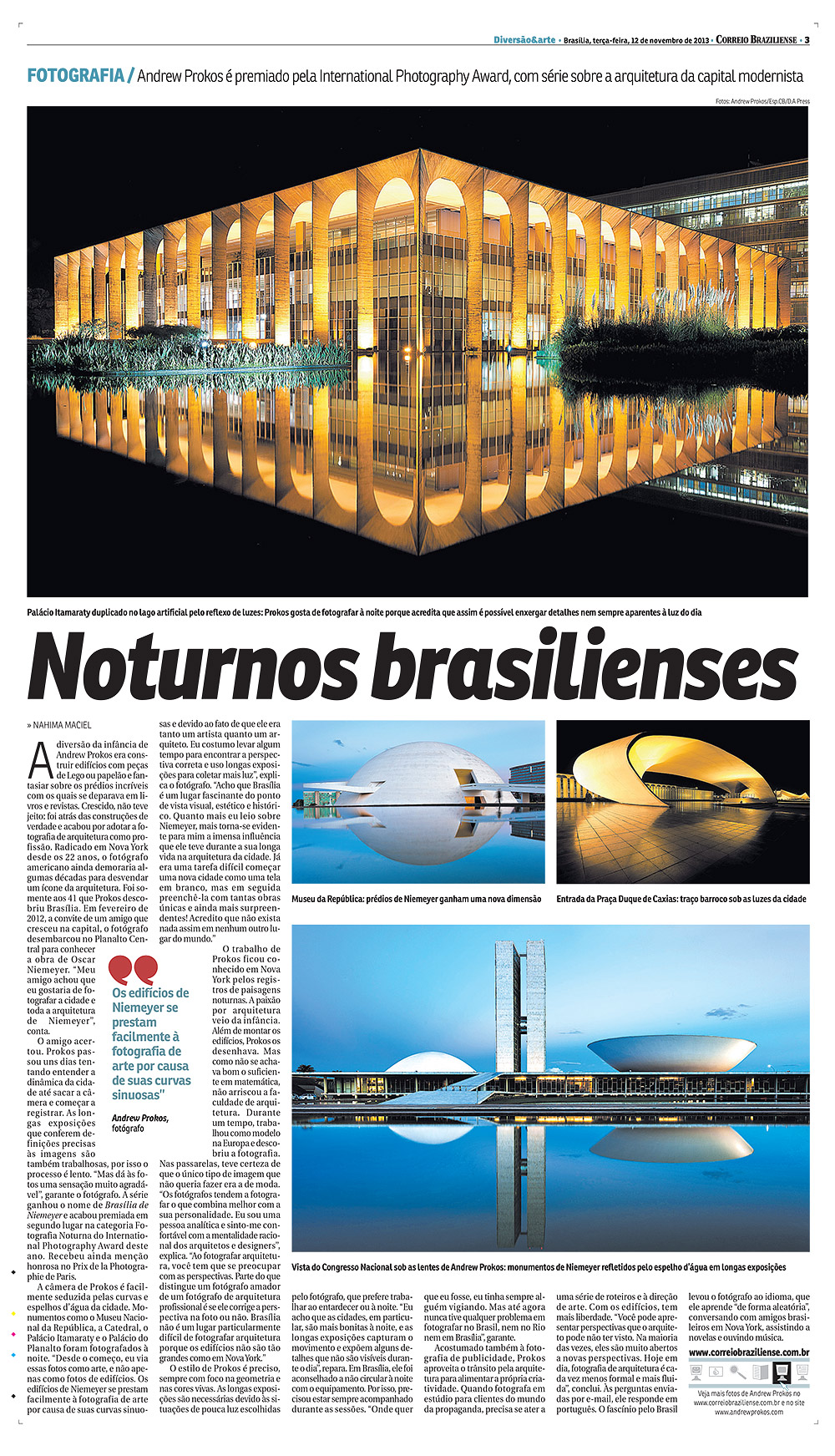
Correio Brasiliense newspaper published a full-page interview with Andrew regarding his award-winning photographs from Niemeyer’s Brasilia. Correio Braziliense is the main newspaper of Brasilia and one of the main national newspapers in Brazil. You can read the interview in Portuguese by downloading the PDF, and the English translation follows below.

Correio Braziliense Newspaper
About This Project
Brasilia Nocturnes
PHOTOGRAPHY / Andrew Prokos is awarded by the International Photography Awards with a series about the architecture of the Modernist capital
By Nahima Maciel
Andrew Prokos’ childhood fun was building buildings out of Lego or cardboard and fantasizing about the amazing buildings he came across in books and magazines. As a grown up there was no other way: he went after real buildings and ended up adopting architectural photography as a profession.
Based in New York since the age of 20, the American photographer would still take a few decades to unveil an architectural icon. It was only at 41 that Prokos discovered Brasília. In February 2012, at the invitation of a friend who grew up in the capital, the photographer arrived at the Planalto Central to see Oscar Niemeyer’s work. My friend thought I would like to photograph the city and all of Niemeyer’s architecture, he says.
His friend got it right. Prokos spent a few days trying to understand the dynamics of the city until he pulled out his camera and started documenting. Long exposures that give images a precise definition are laborious, so the process is slow. But it gives the photos a very nice feeling, the photographer assures us. The series was named Niemeyer’s Brasilia and ended up winning second place in the Night Photography category of this year’s International Photography Awards. He also received an honorable mention at the Prix de la Photographie de Paris.
Prokos’ camera is easily seduced by the city’s curves and mirrors of water. Monuments such as the National Museum of the Republic, the Cathedral, the Itamaraty Palace and the Planalto Palace were photographed at night.
From the beginning, I saw these photos as art, not just photos of buildings. Niemeyer’s buildings lend themselves easily to fine art photography because of their sinuous curves and because of the fact that he was both an artist and an architect.
I usually take some time to find the right perspective and use long exposures to collect more light; explains the photographer. I think Brasília is a fascinating place from a visual, aesthetic and historical point of view. The more I read about Niemeyer, the more it becomes evident to me the immense influence he had on the city’s architecture during his long life. It was already a difficult task to start a new city as a blank canvas, but then fill it with so many unique and even more amazing works! I believe there is nothing like it anywhere else in the world.
Prokos’s work became well-known in New York through his photography of cityscapes at night. His passion for architecture came from childhood. In addition to constructing buildings, Prokos drew them. But as he didn’t think he was sufficiently adept at mathematics, he didn’t risk studying architecture in college.
For a while he worked as a model in Europe and discovered photography during his travels. On the catwalk, he realized that the only kind of photography he didn’t want to do was fashion. “Photographers tend to photograph what best suits their personality. I’m an analytical person in general and I feel comfortable with the rational mindset of architects and designers”, he explains.
“When photographing architecture, you have to be concerned with perspective. Part of what distinguishes an amateur photographer from a professional architecture photographer is if they correct the perspective in the photo or not. Brasilia not a particularly hard place to photograph because the buildings are not as tall as in New York.”
Prokos’s style is precise, always focusing on geometry and vivid colors. The long exposures are necessary due to low light scenes chosen by the photographer, who prefers to work at dusk or at night. “I think that cities in particular are prettier at night, and the long exposures capture the movement and expose details that are not visible during the day”.
In Brasilia, he was advised not to circulate at night with his equipment. That’s why I needed always be accompanied during sessions. Aherever that I went, I always had someone watching. But until now I never had any problems
photographing in Brazil, not even in Rio nor in Brasilia”, he assures us.
Also accustomed to shooting advertising photography, Prokos enjoys the transition through architecture to fuel his own creativity. “When you shoot for clients in the world of advertising you need to stick to the scripted art direction.”
With buildings he has more freedom. “You can introduce perspectives that the architect may not have seen. The majority are very open to new perspectives. These days architectural photography is becoming less and less formal and more fluid”, he concludes.
To the questions we sent by email, he replies in Portuguese. The fascination for Brazil took the photographer to the language, which he learns “somewhat randomly”, talking to Brazilian friends in New York, watching telenovelas in Portuguese and listening to music.